
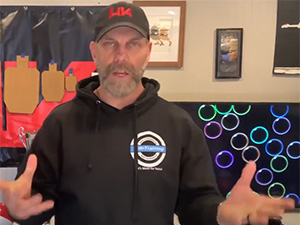
 Last video. Hopefully, you've watched all the other ones. If you haven't, you really need to go back because you're not going to get this part. And they, they're, they're important. They're sequential. The programming needs to work together. Okay, so we've stepped to the line because we're ready. We had good posture. We've settled our eyes. Okay? We've programmed ourselves effectively through visualization and kinesthetic programming. We have taken the struggle and released it through taking a deep cleansing breath. Okay? We have executed. Now, what we need to do before it's over is replay it. If I can replay what just happened in my mind and there's no absences, I know I followed my plan. If there's a big space where I didn't see something or I'd missed something, or I just let information out altogether, I know that my programming was ineffective.
Presence of mind
This is the presence of mind afterward where you see people stay and there's still looking. And part of that is the replay. All right? Have I gotten everything scanned? The environment? Have I done what I said I was doing? Do I see information in front of myself? And if you have missed a target or something still left to do during this phase, part of it is programming. I was supposed to do something about that, and I see that I haven't. All right, maybe I have to go forward here and do something again, or maybe I'm done and I put it away. Or maybe it's a drill and it's over and there's nothing I can do about it. Except realize that maybe I didn't see my sights like I thought I did. Maybe I didn't feel my grip or my breath. Maybe I didn't stand up straight.
You have to be all the time, fully present
Maybe my eyes were unsettled. Maybe I wasn't as present as I wanted to. I wasn't taking in that immediate feedback. Things that you have to be all the time, fully present, immediate feedback in whatever you're doing. Understand the clear goals and challenge yourself. Stretch a little bit more. This allows us to enter the flow state, which gets us out of the front of the mind. All right? This is transient. Hypofrontality means we shut down that big far part, the big part of our mind that actually critiques us and keeps us separate from events and, and tells time. I know my replay is good if I have no real sense of time. Because Oftentimes it'll feel slow. But it went by like that also, that I felt connected to what I was doing in a strange way as if the target and I were unified or the guy that was fighting.
Respect for your Opponent
We had this connection to each other. I'll tell you, as a former fighter, it's very hard to not have respect for someone that you have fought against and it doesn't mean you like them, but you will respect them. Anybody who's willing to stand there and actually do the work, you will respect them, and you'll have a different feeling. And there's a connection. There's a lack of separateness because they are equally important for you to do that. And the person you're competing against may be only who you were yesterday, but we need that person to get better. So I need you to replay this, okay? In training, oftentimes close your eyes and see if you can
Visualize what happened, if there's anything missing. Know that you weren't present, that you weren't taking any information. This is an incredible tool. It came, you know, we'll see a lot of motions where people scan and do all these things, but what they should be doing is they're back half, I accomplish my goals. Can I see everything in my mind? Is there anything else I need to do? And then as a trainer, if the drill is limited, then they do that and they go, all right, I didn't see my sights as well as I thought I did. My programming was an error. I didn't see that I was supposed to do that. I need to practice my reload sequence because I'm not good at it. This is incredibly powerful, guys. These preparatory cues can be done in a heartbeat. The more you practice, it will take you about three months to kind of assimilate it.
Perform at your current level of skill
You'll get better and better, and then you'll look forward to doing these things. You won't have this distance. You won't become overwhelmed or underwhelmed. You won't miss things. You won't do things. You'll perform at your current level of skill because you know what to do. I hope this series helps you feel incredibly passionate about, is really important stuff, and I hope you'll use it. I know it's not a new gun, it's not a new drill. And we're talking about you and people don't tend to pay attention to that. But there's some of you out there that have been struggling, and you're suffering needlessly. Let me help you alleviate the suffering. Training is hard enough. You don't have to make it harder. That is not a part of the purpose of training. It is to face ourselves, to know ourselves, and to be able to communicate with ourselves so it can perform at the highest level. I'm Brian Hill with The Complete Combatant. And as always, measure, refine, and perform.
To Watch Click The Link: https://www.youtube.com/watch?v=6qCYXsasd4E&t=2s
Credit: Brian Hill, Co-Owner of https://www.thecompletecombatant.com/
Check out our course for HGP in Maryland.